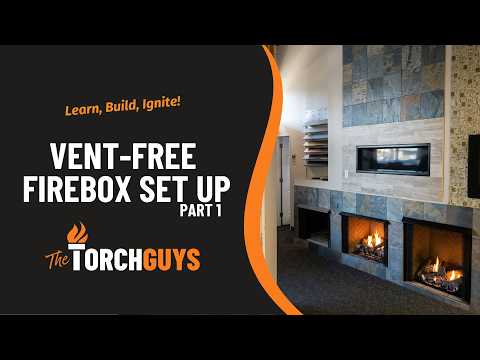
Monessen Lo-Rider LCUF42 42" Vent Free Gas Firebox
Zero clearance to combustibles at the back, sides, top and floor — no chimney, no vent run. The Monessen Lo-Rider 42 (LCUF42) is the enclosure half of a vent-free fireplace, built flush to the floor with an extra-tall 42" x 30" clean-face opening in a 48" W x 34" H x 23" D heat-circulating firebox, listed to CSA/ANSI Z21.91 to host any listed vent-free gas log heater up to 40,000 BTU/hr, sold separately. Interior panels come with the firebox — cement-gray stacked concrete, or multi-tonal brown or gray refractory — the hood and mesh firescreens ship in the carton, and a junction box is built in for a blower or light kit. from $1,259.
Choose the Lo-Rider 42 if you want the look of a hearth-level wood-burning opening where a chimney or vent run is impossible or too costly — it frames into a 48-1/2" x 34-1/4" x 22-3/4" rough opening, straight or in a corner, sits flush on an ordinary combustible floor, and takes the 24" and 30" vent-free log sets you pick separately. Its 30"-tall opening is the tallest in Monessen's vent-free firebox line, the angled box pushes more of the heat forward, and the LSD-42 mesh doors fit this size.
It is not right for a bathroom, or for a bedroom unless the heater you put in it is rated 10,000 BTU/hr or less — those limits come with any unvented gas heater. It is not a primary heat source, it burns room air and adds moisture to the room, so a very tightly sealed house that cannot spare combustion air or add mechanical ventilation is the wrong home for it. It is also not a wood-burning fireplace and never takes a vented log set or glass doors: if you want to burn wood or vent the flame outside, look at a direct-vent or wood fireplace instead.
Specifications
Frame a rough opening 48-1/2" wide by 34-1/4" high by 22-3/4" deep; corner framing is tabled in Figure 3.3 on page 8 of the installation manual. The firebox itself is 48" wide across the face, 35-1/2" at the back, 34" high and 23" deep, and weighs 210 lb with the concrete panels or 115 lb with the multi-tonal panels. The floor inside measures 38-7/8" across the front, 15" deep and 30-3/8" across the back, with 28-1/2" of height at the front and 22-5/8" at the back — the figures Monessen publishes for sizing a log set. Clearance to combustibles is 0" at the back, sides, top and bottom; keep 9" from the opening to a perpendicular side wall, 42" from the opening to the ceiling, and 36" from the front to anything flammable. Combustible mantel and mantel-leg clearances depend on how far the mantel projects — see Figures 7.1 through 7.4 on pages 18 and 19 of the installation manual. Non-combustible facing up to 4 inches thick may cover the metal front faces. The gas line enters through a left- or right-side knockout; the junction box takes unswitched 110-120 VAC when the log set or an accessory needs it.
How the Lo-Rider 42 compares to the 36 and the See-Through
The two single-sided Lo-Rider sizes share the same 30"-tall opening, 34" height, 23" depth, interior-panel choices and accessory list; they differ in width. This 42" gives a 42" x 30" opening in a 48"-wide, 35-1/2"-back firebox at from $1,259; the 36" narrows the opening to 36" x 30" in a 42"-wide, 29-1/2"-back box at from $1,179. The framed opening shrinks with the size — 48-1/2" wide here, 42-1/2" on the 36 — while framing height and depth stay at 34-1/4" and 22-3/4". Both take the 24" and 30" vent-free log sets and the same accessory list, each in its own width. A see-through Lo-Rider (LSTF36-B) with a 36" opening on each side and concrete panels standard is sold as its own product.
Features
- 42" x 30" extra-tall clean-face opening on a flush-hearth, louverless firebox — the look of a wood-burning fireplace with no chimney
- Zero clearance to combustibles at the back, sides, top and floor — no chimney and no vent run
- Hosts any listed vent-free gas log heater up to 40,000 BTU/hr, sold separately — CSA design certified to fit most 18", 24" and 30" sets
- Four factory interiors — cement-gray stacked concrete, or multi-tonal brown or gray stacked and gray herringbone refractory — with reflective black glass as the optional fifth
- Heat-circulating radiant clean face with a built-in junction box — blower-ready and light-kit-ready with in-firebox or remote wall-box controls
- Hood and two mesh firescreens that tuck into hide-away pockets ship in the carton
Answers to common questions
What’s included, what’s required, and what’s optional?
-
Included in the box: 42" x 30" clean-face firebox opening; Interior panels — concrete or multi-tonal refractory; Hood (must be installed); Two mesh firescreen panels with hide-away screen pockets; Built-in junction box; UL listing to CSA/ANSI Z21.91:20; HHT limited warranty — 20 yr parts / 3 yr labor on the firebox.
-
Required to complete the installation, purchased separately: Vent Free Log Set (burner + logs/media) - make sure the Lo-Rider LCUF 42" Firebox meets the minimum firebox dimensions. For a 42" box, The Torch Guys recommend 24" - 30" log sets; Gas Line - run by a qualified installer or licensed plumber through the left- or right-side knockouts, with a regulator upstream if line pressure exceeds 1/2 PSIG.
-
Optional: The 42" Contemporary Front, the trim kit for cabinet or drywall finishes, the LSD-42 mesh doors, the GFK-160VF blower, the MONAL-VF accent light kit, and the AKD outside air kit with 4" flex duct — the firebox operates fully without any of them; electrical power (unswitched 110-120 VAC to the junction box) is only needed when the log set or an accessory calls for it.
Does it need a chimney or a vent?
No — nothing about this firebox vents outside. The heater it hosts uses air from the room, so the installation must provide adequate combustion and ventilation air and stay out of drafts from exhaust fans, ceiling fans, return-air registers, windows and doors; an extremely tight home needs additional mechanical ventilation. Where a room runs tight, the optional AKD outside air kit ducts combustion air in through the side of the firebox.
Which log sets fit?
The firebox floor measures 38-7/8" across the front, 15" deep and 30-3/8" across the back, with 28-1/2" of height at the front and 22-5/8" at the back — those are Monessen's minimum-hearth figures for sizing a set, and the series is CSA design certified to fit most 18", 24" and 30" vent-free sets. The 42" takes 24" and 30" vent-free log sets, and any listed vent-free heater up to 40,000 BTU/hr may be used as long as the firebox meets that heater's own minimum size. Above 2,000 ft the heater's input is reduced 4% per 1,000 ft.
Where can it go — and where can't it?
Any ordinary living space that can spare combustion air — framed into a flat wall or a corner, flush on a combustible floor, with a perpendicular wall at least 9" from the opening and the ceiling at least 42" above it. Keep flammable objects 36" from the front, and over carpet, tile or vinyl set it on a metal or wood panel covering its full footprint with no carpet or vinyl within 14" of the opening; vinyl that runs to the wall calls for 14" of floor protection in front or a 12" raised opening. The unvented heater inside it cannot go in a bathroom, and only a heater rated 10,000 BTU/hr or less may go in a bedroom.
How high must a mantel or shelf be, and can a TV go above it?
The mantel answer depends on how far the mantel projects: combustible and non-combustible mantel and mantel-leg clearances are charted in Figures 7.1 through 7.4 on pages 18 and 19 of the installation manual, and reducing them means building the surround in non-combustible material to 12 inches above the framing height. Send us your mantel depth and we will read the chart with you. For a television, Monessen prints good-faith guidelines only — 17" from the top of the opening to a combustible mantel, 12" to a non-combustible one, shown in Figure 7.5 on page 20 — with the TV maker's own maximum operating temperature the deciding limit, so verify the actual TV temperature at installation.
Does it use electricity?
Only if something in it needs power. A junction box is built into the firebox and is wired to unswitched 110-120 VAC (the rating label reads less than 3 A at 115 V); not every log set needs 110 VAC, so a millivolt set can run with no power at all. Wire it in before the wall is closed if you might add the GFK-160VF blower or the MONAL-VF accent light kit — their controls mount in the firebox or in a remote wall box, and a circuit near a sink or in a bathroom must be GFCI-protected.
What are the interior panel choices?
Four factory builds and one add-on. The LCUF42CR-C ships with cement-gray stacked-traditional concrete panels — a concrete hearth plus left, back and right panels, which is why it weighs 210 lb against 115 lb for the others. The LCUF42CR-BT ships with multi-tonal brown stacked panels, the LCUF42CR-GT with multi-tonal gray stacked panels and the LCUF42CR-GH with multi-tonal gray herringbone panels. The fifth choice, Reflective Black Glass, adds the L42BGL black glass interior to the concrete-panel firebox at extra cost. The opening, hood, screens, clearances and framing are the same whichever you pick.
How does the warranty work if something goes wrong?
Hearth & Home Technologies warrants the firebox for 20 years on parts and 3 years on labor, the concrete and glass panels for 2 years, and the junction box and other electrical parts for 2 years — coverage that transfers to a later owner of the home but applies only when the firebox was bought from an authorized dealer. The Torch Guys handles the claim for you: keep your invoice and the model and serial number, and we deal with the manufacturer on your behalf rather than handing you a phone number.


 Pro Portal
 Dedicated Support
 Best Price
 Large Selection
 Exclusive Deals
 Priority Shipping