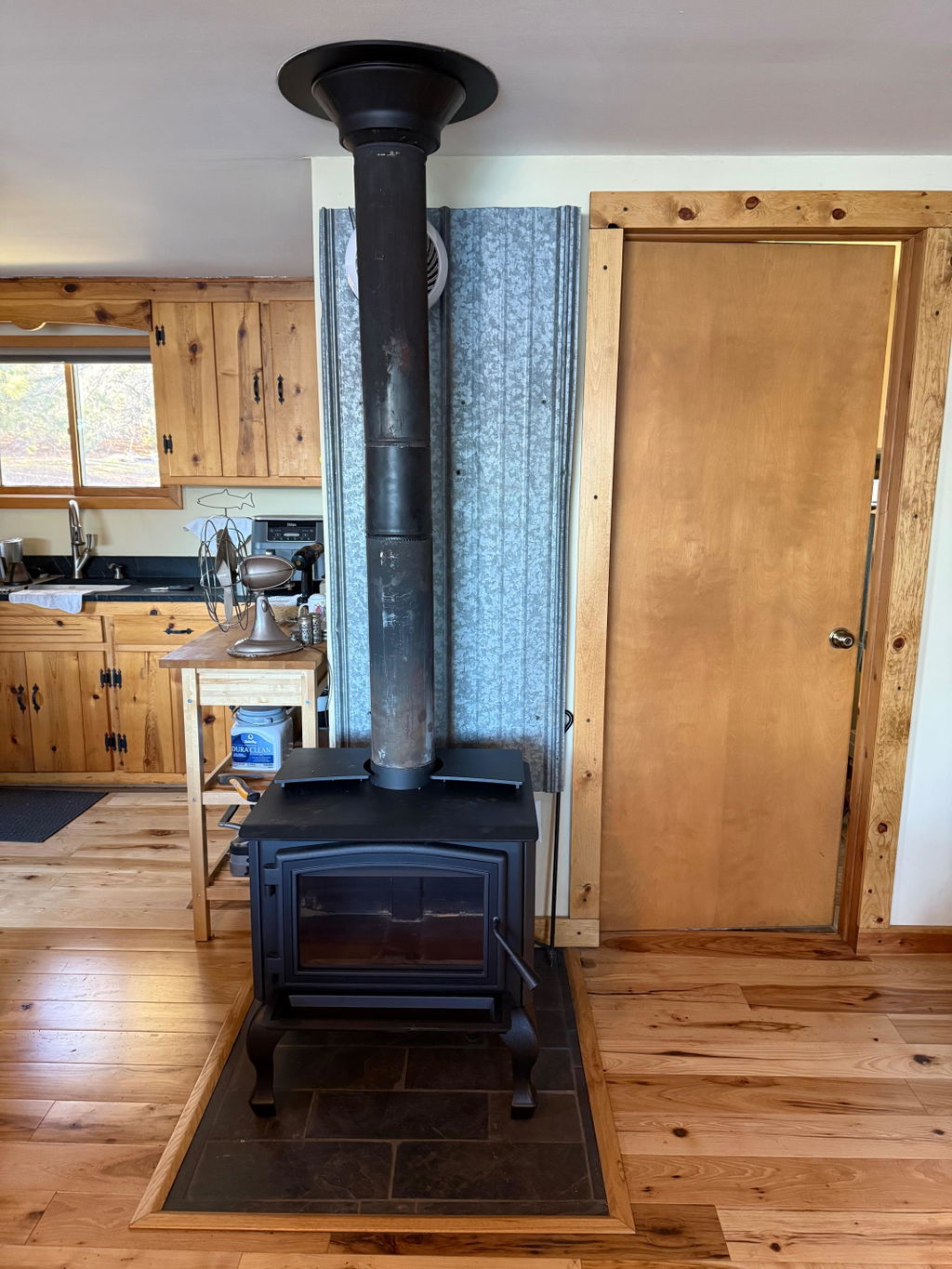
Osburn 1700 EPA 2020 Wood Stove
65,000 BTU/hr from dry cordwood and a 1.86 cu ft firebox rated for 500 to 1,800 square feet. The Osburn 1700 is an EPA 2020 certified non-catalytic wood stove with a cast-iron door, 5/32" ceramic glass, 76% optimum efficiency, burn times up to 7 hours and a 6" flue outlet, from $2,309 for the stove alone — the door overlay and the pedestal or legs you choose above are required to complete it and are priced on top — and a limited lifetime warranty on the firebox welds and door frame.
Choose the 1700 if you want Osburn's cast-iron-door stove sized for a smaller space: it is a smaller version of the Osburn 2000, taking 16" logs up to 18" with burn times up to 7 hours. You pick the look — a pedestal, or straight or traditional cast-iron legs in black or brushed nickel, each with an ash drawer, and a black or brushed nickel door overlay. It is approved for mobile homes and alcoves, and the 130 CFM blower is an add-on when you want to push heat further.
It is not right if you need to heat more than about 1,800 square feet — that is the Osburn 2000's job — or if you want an open fire. In the United States the door stays closed while it burns; burning with the door open behind the rigid firescreen is prohibited. It needs a 6" connector to a UL 103 HT factory-built chimney or a code-approved lined masonry chimney, at least 12 ft tall, a ceiling at least 84" above the base of the stove (down to 78" with the larger lowered-ceiling clearances in section 3.1.2 of the installation manual), and ember protection on any combustible floor, and no blower comes with it.
Specifications
In the United States, with a single-wall connector keep 13" to a combustible back wall, 10" to the sides and 12" in a corner; a double-wall connector brings the back to 6" and the corner to 6", with the sides unchanged at 10". In a standard installation the ceiling is at least 84" above the base of the stove (a lowered ceiling down to 78" is allowed with larger wall clearances, section 3.1.2), and the front clearance is drawn in Figure 25 on page 16 of the installation manual. Alcove, lowered-ceiling and mobile-home clearances are tabled in sections 3.1.2 to 3.1.6, pages 18-21. On a combustible floor, lay continuous non-combustible ember protection 16" in front of the door opening and 8" to each side of it — a 31-3/4" x 35-1/4" area — with no R-value required. The stove stands 30-3/8" high, 24-7/8" wide and 23-1/4" deep on the pedestal, 29" high and 25-7/8" wide on traditional legs; the straight-leg dimensions are drawn in Figures 4-6 on page 8 of the installation manual. The flue outlet and connector are 6".
How the 1700 compares to the Osburn 2000
The Osburn 2000 is the larger version of this stove — a 2.4 cu ft firebox against the 1700's 1.86, 75,000 BTU/hr against 65,000, 500 to 2,100 square feet against 500 to 1,800, burn times up to 8 hours instead of 7, 20" logs instead of 18", and a 130 CFM blower included. The 1700 starts from $2,309; the 2000 starts from $2,859. Pick the 1700 when the room is smaller and you would rather add the blower only if you need it.
Features
- EPA 2020 certified non-catalytic wood stove — 65,000 BTU/hr maximum on dry cordwood, 76% optimum efficiency and 2.4 g/h particulates, rated for 500 to 1,800 sq ft
- 1.86 cu ft firebox for 16" logs (18" maximum) loaded east-west, with burn times up to 7 hours
- Cast-iron door with 5/32" ceramic glass, air-washed, and a 15-3/4" x 9-3/8" view of the fire
- Pedestal or cast-iron straight or traditional legs in black or brushed nickel, each with its ash drawer, and a black or brushed nickel door overlay to match
- Approved for mobile homes and alcoves, with a top heat deflector that sends heat forward and side panels that reduce clearances
- Blower-ready — add the 130 CFM variable-speed blower, whose thermodisc runs it only when the stove is hot
Answers to common questions
What chimney does the 1700 need, and is any of it included?
None of the venting ships with the stove. The 1700 has a 6" flue outlet and takes a 6" connector pipe to either a factory-built chimney listed to ULC-S629 / UL 103 HT (2100 °F) or a code-approved masonry chimney with a flue liner, at least 12 ft tall. The connector can be single-wall or double-wall, and the choice changes the clearances — double-wall lets the stove sit 6" from a back wall instead of 13". In a mobile or manufactured home only a double-wall connector is allowed.
How close can it sit to a wall, and what goes on the floor?
In the United States, with a single-wall connector keep 13" to a combustible back wall, 10" to the sides and 12" in a corner; with a double-wall connector it is 6" at the back, 10" at the sides and 6" in a corner. In a standard installation the ceiling is at least 84" above the base of the stove; a lowered ceiling down to 78" is allowed with larger wall clearances (section 3.1.2 of the installation manual). On a combustible floor it needs a continuous non-combustible ember pad — steel at least 0.015" thick, grouted tile over a continuous non-combustible sheet, cement board, brick or another listed material — reaching 16" in front of the door opening and 8" to each side of it, with no R-value required. A concrete floor needs none. The front clearance is drawn in Figure 25 on page 16 of the installation manual.
What’s included, what’s required, and what’s optional?
-
Included in the box: Cast-iron door with 5/32" SCHOTT ceramic glass and air wash; High-density refractory brick lining, baffle and four secondary air tubes; Top heat deflector and side panels; Single air control under the ash shelf; EPA 2020 certification, UL 1482 / UL 737 / ULC S627 safety listing, and the Osburn limited lifetime warranty.
-
Required to complete the installation, purchased separately: Door Overlay - the black or brushed nickel overlay that finishes the cast-iron door frame; the stove ships without one (choose above); Base - the pedestal or a set of cast-iron straight or traditional legs, each with its ash drawer; the stove ships on freight supports and needs a base to stand on (choose above); Venting - a 6" connector to a listed UL 103 HT (2100 °F) factory-built chimney or a code-approved masonry chimney with a flue liner, at least 12 ft tall (see pg 6 in the installation manual and pg 7 of the owner's manual); Floor Protection - a continuous non-combustible ember pad under the stove and 16" in front of the door opening, no R-value required; not needed on a concrete floor; Outside Air - in a mobile or manufactured home, the 5" fresh air intake kit for legs or pedestal and insulated fresh air pipe; in any home the room needs an outside or fresh air supply for combustion (see section 6.6 of the owner's manual).
-
Optional: The rigid firescreen, the 130 CFM blower, the 5" fresh air intake kits, register and insulated pipe, and floor protection pads sized for the stove — the stove burns and heats without any of them.
How much space will the 1700 heat?
Osburn rates it for 500 to 1,800 square feet with a 1.86 cu ft firebox and burn times up to 7 hours on dry cordwood. Climate moves that number — Osburn's climate-zone table puts the maximum at 2,400 sq ft in the mildest zones, 1,800 in zone 6 and 1,500 in the coldest (7-8) — and the layout of the home, chimney draft and heat loss matter too. If you need more, the Osburn 2000 covers up to 2,100 sq ft.
Can it go in a mobile or manufactured home?
Yes, on either base. There it needs the 5" fresh air intake kit for legs or for the pedestal with insulated fresh air pipe, a double-wall connector (single-wall is not allowed) and the stove bolted to the floor through its legs or pedestal; it must not go in a sleeping room, the structural integrity of the home's floor, walls, ceiling and roof must be maintained, and the rigid firescreen may not be used.
Can I burn it with the door open behind the firescreen?
Not in the United States. Burning with the door open behind the rigid firescreen is prohibited in the US and in any province with a particulate emission limit, and it is never allowed in a mobile home; the door stays closed while the stove runs. Where the screen is allowed, the stove is never left unattended with it in place.
Does buying online affect my Osburn warranty?
No. The warranty is Osburn's and applies to every configuration on this page; it runs from your dated purchase invoice, so keep it and register the stove online at osburn-mfg.com with the model name and serial number from the nameplate on the back. The Torch Guys will help you with any claim. Coverage is a limited lifetime on the combustion chamber welds and cast-iron door frame (5 years labour) and on the ceramic glass, 7 years on the legs, pedestal, ash drawer, baffle and air tubes, 5 years on the handle, glass retainers and air control, 2 years on the blower and controls, and 1 year on paint and gaskets. It requires installation by an authorized qualified technician and covers the original purchaser only.